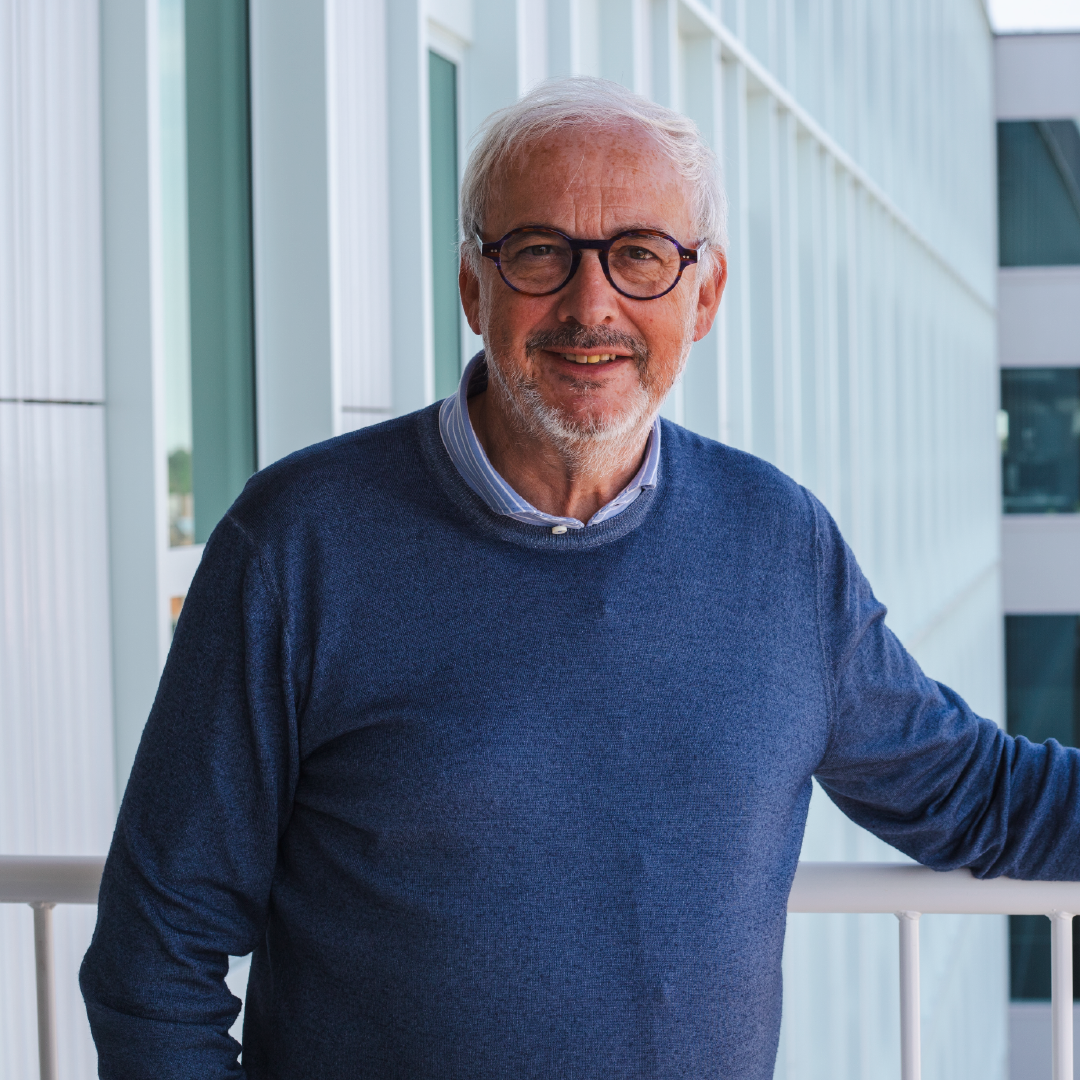
Bart Verduyn, Founder
Complex innovations clearly explained… for every stakeholder.
After 34 years, our new strapline and visual identity feel like a kind of homecoming.
Over the years, we have gone through several phases. At times we were very intellectual. At times highly technical. At times very much an “agency”. But gradually we distilled everything down to the essence of what we truly do — and have always done, even when we called it something else ourselves: making innovation rapidly implementable by translating it transparently into a clear story. That is the core.
And perhaps that core also explains why, in 2002, when we presented Living Stone to the international marketing team of the healthcare group Mölnlycke — in the Swedish village of the same name — we received a reaction that has stayed with us ever since. They were impressed and wondered aloud why they had never heard of us: “Why didn’t we know you? Where have you been hiding?”
At that point, we had been around for ten years. And it marked the beginning of a beautiful and long-lasting collaboration at EMEA level.
That anecdote is a fitting starting point for me, because it reveals something that is still true today: Living Stone has never jumped on the bandwagon of a hype. Instead, we have continuously adapted to a world that is constantly changing — and above all to a world that is becoming ever more complex, with an increasingly strong technological component. And the more complex the world becomes, the more important our core mission is: creating clarity that enables adoption.
1992: before Google, before the iPhone, before “digital first”
When we started in 1992, communication was fundamentally different. The World Wide Web existed, but it was not yet part of everyday life. No Google. No social media. No smartphone in everyone’s pocket. International communication revolved around print, events, press, videos on physical media, and above all: relationships — meeting people face to face and building reputation.
That year, I was reporting for an economic circle of the King Baudouin Foundation, when a senior executive at Alcatel — still Bell at the time — asked us to handle their communications. Bell took us to Paris, and year after year we produced more than a hundred customer reference stories around the world. That work laid the foundations for two things that would continue to define us: an international network of communication experts and a natural affinity with technology companies such as Nexans, IBM, Oracle, ABB, Atlas Copco and Vaillant.
It was an era in which technology was impressive, but rarely self-explanatory. Anyone who wanted innovation to take hold had to be able to explain it. Clearly. Humanly. Credibly.
Late 1990s: the internet goes mainstream — and everything accelerates
When the web became mainstream in the late 1990s, a wave of acceleration began that is still felt today. Organisations discovered websites, digital information, new forms of reach and an early version of “always on”. What had once worked in a linear way suddenly became continuous and international.
Our work, too, took on a new dimension: from classic communication to communication that took account of new channels, new speed and new expectations.
And then there was an Antwerp (once again) icon that immediately understood our work: Agfa. We were their first agency “from across the water”, and we produced their global graphic publication in 16 languages. We built the group’s first web page for the healthcare division. Today that may seem like a footnote, but at the time it was a signal: healthcare was on the brink of a digital transformation — and we were ready.
2000–2010: healthcare becomes digital at its core (and therefore more complex)
From the early 2000s onwards, digitalisation began to penetrate deep into the heart of hospitals. Radiology evolved from film and physical archives to digital images and digital information flows. That transformation affected not only technology, but also collaboration: data had to be shared, systems had to interconnect, and processes had to be redesigned.
Agfa Healthcare took us into hospitals across Europe. We stood literally alongside clinicians and managers as traditional radiology gave way to digital radiology. In those conversations, we noticed something that gave us direction: people were often enthusiastic about innovation, but at the same time there was friction. New technology brings new questions. About workflow. About training. About responsibility. About reliability. About adoption.
Hospital managers and clinicians were often enthusiastic in our interactions for Agfa, and this led to us becoming the preferred communications partner for AZ Sint-Jan Bruges. With the support of the CEO, we helped pull the hospital out of a positioning quagmire: AZ Sint-Jan did not need to pretend to be a university hospital, but rather position itself as the best alternative to one. After all, West Flanders is the only Flemish province without a university hospital.
In a period when healthcare was professionalising at pace, one insight became increasingly clear: you do not sell innovation on features. You build trust with a story that is clinically sound and organisationally feasible.
2010–2020: data, platforms and new expectations
During the 2010s, society shifted up another gear: smartphones became the primary screen, the cloud became infrastructure, and data became the language of policy and management. Healthcare followed the same trajectory: more measurability, more dashboards, more integrations, and more stakeholders involved in decision-making.
And that made the sector even more complex. The more digital healthcare becomes, the more you must take into account interoperability, privacy, security, compliance and change. The story shifts: not just “what does it do?”, but also “how does it fit into everything that already exists?”
Our knowledge of the healthcare sector led us to work with major medical, medtech and pharmaceutical groups such as Roche, Alcon, Abbott, Johnson & Johnson, Terumo, Cerus, CSL Behring, Takeda and Becton Dickinson. But we are just as keen to work with start-ups and scale-ups — because innovation there is often raw and ambitious, and because that is precisely where the gap between what is “possible” and what is “acceptable” becomes most visible.
2020–today: pandemic, acceleration and the age of adoption
And then COVID arrived. The pandemic was not a “digital trend”, but an accelerator. Remote consultation, hybrid collaboration, telecare, pressure on staff, pressure on capacity: healthcare had to keep running while also undergoing fundamental change.
Today — in a world where AI and automation are once again accelerating the pace — that reality is even sharper. Innovation is everywhere, but adoption is harder than ever. Not because healthcare does not want to change, but because the conditions are more stringent and the context more complex: governance, regulation, security, data ethics, integration, training, procurement, budgets and reputational risk.
That is why Living Stone is once again redefining itself today, 34 years on. But this time it does not feel like “yet another new look”. It feels like coming home, because in this rebranding we have not added anything — we have stripped away everything that was not essential.
Making complexity clear.
A simple sentence that, in fact, encapsulates an entire history.
Coming home — also to the place where the future is being built
We recognise that same movement in something very tangible: where we work today and who we surround ourselves with. I am immensely proud of our team. In and around Living Stone, we have gathered a circle of reliable and highly skilled experts — young, dynamic, and united by the desire to speak plainly and give clarity form. After so many years in the profession, I know this to be true: the real pleasure comes from working with professionals, from the relationships that emerge and grow. That is what my memories of these 34 years are built around.
We feel at home at WATT The Health, an initiative by Revive and AZ Maria Middelares, with whom we share the ambition of turning Ghent into a hotspot for medtech innovation. The site brings together a wide range of healthcare actors: the day clinic, the sports medical centre, the residential care centre and the neighbourhood health centre. WATT The Health connects health and business at a deeper level, giving the technological innovation that Flanders has to offer a fresh boost.
That, too, feels like coming home. Because that is exactly where it happens: at the crossroads where innovation is not only conceived, but must also be applicable. Where technology only gains value once it lands in practice. And where, more than ever, transparency, trust and a clear story are essential.